
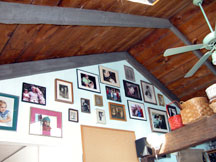
There are many more on this Finlay wall, but this is all I could capture in a single pic.
Huge View
After we (inlcuding Patti’s long time friend, Sally) finished hanging new pictures on this wall, Emma ran to her room to retrieve her favorite photo of her mother.
Monthly Archives: March 2005

Rocks and Salt

Early Saturday afternoon, before visiting Flo, we drove Peter and Emma to La Cantina for PeterÃs birthday, and made sure he ordered a margarita with rocks and salt. Before Paula brought them to our table, I ran to my truck for my camera. When I returned, Emma made a not-another-photo face and I felt a need to explain myself. ìAuntie Sue loves this place and her favorite drink is a margarita with rocks and salt. ì
Chris will appreciate this: After Peter finished his margarita he said, ìThat was good, now if only I could have four or five more.î
Emma eating a cheese quesadilla.
Helen. ìDr. Bieker told me, again, itÃs time to move closer to my children.î
Me. ìRemember what happened to Lillian?î
Lillian, my motherÃs mirror spirit, lost her husband of forever, and lived alone for years before moving from Evansville to be near her daughter in Florida. I remember sitting in LillianÃs kitchen, with my father, and as she passed arrowheads across the table to me to give to Matthew, she said, ìI never had a thought about my mortality until I turned ninety.î Lillian smiled as she talked about her now tenuous future. She always smiled, even while she was helping her husband feed himself.
ìShe lived about a year.î
ìIÃm afraid the same might happen to you. Helen and Malcolm moved to Gaithersburg to be near their daughter. May they rest in peace.î
ìThat is what I am afraid of. That the move will kill your father. î
Chugging Along
Rakkity is in Spain with the Mrs. and their daughter, KT. He has promised to send updates. Adam, before he and Tricia left for a birthday celebration in Connecticut, sent me a photo to post. He called it a tiny bone. A generous mother, who for the moment will remain anonymous, has provided me with her daughter’s baby pictures. I will post them this week. So you see, though this blog did grind to a temporary halt, it will, like one of those serpentine midwestern freight trains blocking the road in front of you, start again.
Two Hats
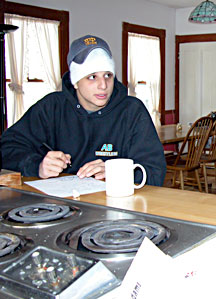
Joe Barbato
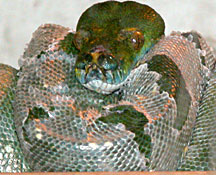
Kyle’s snake
View larger image
This Summer
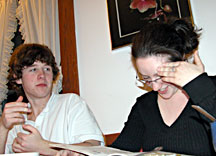
Hil stopped by for dinner last night so she and Matthew could talk to us about possible summer plans. Bouncing around the table: A return to Nicaragua, but pick a different city and a different activity. Matt wonÃt again sit for four hours a day of Spanish lessons. Guatemala, but it is safe? Colombia, but would they return home alive?
Knocked from the list: Costa Rica and Mexico – too ordinary, too safe. South America? Who knows anything about those countries? If they go somewhere, everyone, even Matthew agrees that they should have structure, as in community service, etc. . Preferred by the ërents and maybe even the deal breaker, known contacts in the area.
Anyone out there with ideas?
From the book The Unsubscriber by Bill Knott:
Untitled
Fingerprints look like ripples
because time keeps dropping
another stone into our palm.
From the review of The Unsubscriber in Poetry, the magazine Adam and Tricia gave me for my last birthday.
The Unsubscriber is KnottÃs first new collection in a decade, and it is something of an event, in part because Farrar, Straus and Giroux – home to Noble Prize-winning Derek Walcott and Pulitzer-winning, John Ashbery, as well as many distinguished others – is publishing it. And a good thing, too, because, as it turns out, Knott is an underrated, or at least an under-read, poet. To be sure, he is also plenty capable of bad – not to mention offensively grotesque – poetry, of a sort that is more unsettling than the average tediously bad poem. But his talent is a kind of live wire: no one, least of all the poet himself, seems to be able to get a consistently steadying hand on it, and if the result is sometimes appalling, it can also make for a kind of terrifying beauty.
Letting Go
ìDo you have children?î
ìI have three. I had three. My son, Rajiv, died when he was a young boy.î
While I stood outside talking to Adam on my cell phone, Maya set a place for me at her kitchen table. I walked back inside to see ìsomething before you begin workî: a mug of spicy Indian tea, a paper cup of water, two round, tan-colored chappathis, two cookies, and a handful of pistachio nuts. She stood some distance away on the other side of the kitchen, and when she told me about Rajiv she looked away, as if into another room.
Later, I walked to where she had glanced and on the kitchen counter was a small shrine . Inside an open cabinet that would normally hide a blender or a toaster was a photo of her son at about four: round face, dark brown eyes, hair cut short, and a smile perhaps coaxed by an adoring mother standing behind the photographer. On narrow shelves above and below his photo were carelfully set Hindi religious objects.
ìWhat God gives, God takes away.î
Maya seemed equally at ease talking about her son as sitting in her worship room with the sun streaming through the skylight two stories above. She wore a red sari, the same color as her third eye dot, with a flowery pattern sewn into the hem. Her white sandles were either on or off depending on which room she entered. She told me sheÃd moved to Weston thirty-six years ago and that her eldest daughter had married after graduating from Northwestern.
ìI didnÃt think Hindus believed in such a God. That sounds very Christian.î
ìWe believe in God, one God, and that we are all a small part of God. All religions are the same. The Jews have a saying, ìWhat goes around, comes around… .î
ìReincarnation?î
ìYes. We believe we have eighty-four incarnations and what you donÃt learn in one lifetime you learn in another.î
ìBut your son…it must have been rough.î
ìIt was very rough for three or four years, but when my second daughter was born I realized it was okay. And my aunt-in-law told me that if I love my son, I have to let him go. That my holding on would make him unhappy.î
ìEasy for others to say. But you were ready to let go after those years of suffering?î
ìI was, and I watched my husband. HeÃs so strong and he, better than I , accepted what was happening.î
ìYou must have gotten much closer then.î
ìWe did. We were not close before that. I hate to say it, but we werenÃt. It was an arranged marriage… ì
ìOf course.î
ì…but not forced.î
ìYouÃve accepted your sonÃs passing… ì
ìIt still hurts. Now and then it catches me when IÃm not aware.î
ìDid you talk to him at the end?î
ìOh yes. He knew more than we did. His doctor said Rajiv had the brain of a sixteen year old, though he was only ten. The doctor told his other patients they should be like my son.î
ìWere you able to say goodbye?Ã
ìNo. I couldnÃt .. .î
ìYou…î
ìI couldnÃt face the reality. You know he would have thirty-five this year.î
Today’s required reading
As a Word Doc to read on the plane to Spain.
Room with a view (Thanks to Chris)
Fill'er Up
Betty toils behind the counter at my local lumberyard. She is short and slim, has brown hair and a childlike Betty Boop sounding voice, which is odd coming from a woman who must be in her mid-forties. Her voice makes me want to go home and watch cartoons.
I placed a quart of ceiling paint on the counter.
ìAnything else you need?î
ìNo, thatÃs it. And I see you are bundled up again.î I looked around and she was the only one wearing more than a long sleeved shirt. Even teardrop-shaped Al who often wears sweaters sported only pin stripes.
ìNo blood.î
ìNo what?î
ìNo blood. I am always cold and growing up my Swedish grandparents told me I didnÃt have enough blood.î
ìAnd your parents… ?î
ìMy mother died when I was four and my father was no good. I plopped into my grandparents’ lives when I was four and they were about fifty.î
ìI lived next to a couple who raised their two granddaughters after the girls’ parents were killed in an auto accident. The grandmother lived forever, but not so for the grandfather.î
ìMine lived into their eighties and they died a month apart.î
ëThat must have been awful. I mean, they were your parents,really.î
ìIt was and they were. I was in my thirties then.î
Betty turned away to retrieve my printed sales receipt. I could see another salesman, David, who could play a perfect mall Santa Claus, sitting behind his desk, listening. Betty returned.
ìAnd they thought you needed more blood?î
ìI was hungry all the time. IÃd eat all day and my growling stomach would wake me at night for another meal. And I couldnÃt stay warm. When they cooked a roast beef they would pour the blood and the fat from the bottom of the pan into a glass and make me drink it.î
ìThat sounds delicious.î
ìIt was terrible, especially the fat. I drank it from nine until about twelve, but as a teenager, they couldnÃt make me drink it.î
ìItÃs funny, isnÃt it? The stuff that gets handed down. In extreme climates like the arctic that fat would be good for you.î
ìNow I just wear a sweater.î
Fill’er Up
Betty toils behind the counter at my local lumberyard. She is short and slim, has brown hair and a childlike Betty Boop sounding voice, which is odd coming from a woman who must be in her mid-forties. Her voice makes me want to go home and watch cartoons.
I placed a quart of ceiling paint on the counter.
ìAnything else you need?î
ìNo, thatÃs it. And I see you are bundled up again.î I looked around and she was the only one wearing more than a long sleeved shirt. Even teardrop-shaped Al who often wears sweaters sported only pin stripes.
ìNo blood.î
ìNo what?î
ìNo blood. I am always cold and growing up my Swedish grandparents told me I didnÃt have enough blood.î
ìAnd your parents… ?î
ìMy mother died when I was four and my father was no good. I plopped into my grandparents’ lives when I was four and they were about fifty.î
ìI lived next to a couple who raised their two granddaughters after the girls’ parents were killed in an auto accident. The grandmother lived forever, but not so for the grandfather.î
ìMine lived into their eighties and they died a month apart.î
ëThat must have been awful. I mean, they were your parents,really.î
ìIt was and they were. I was in my thirties then.î
Betty turned away to retrieve my printed sales receipt. I could see another salesman, David, who could play a perfect mall Santa Claus, sitting behind his desk, listening. Betty returned.
ìAnd they thought you needed more blood?î
ìI was hungry all the time. IÃd eat all day and my growling stomach would wake me at night for another meal. And I couldnÃt stay warm. When they cooked a roast beef they would pour the blood and the fat from the bottom of the pan into a glass and make me drink it.î
ìThat sounds delicious.î
ìIt was terrible, especially the fat. I drank it from nine until about twelve, but as a teenager, they couldnÃt make me drink it.î
ìItÃs funny, isnÃt it? The stuff that gets handed down. In extreme climates like the arctic that fat would be good for you.î
ìNow I just wear a sweater.î
What Are The Odds?
Last year, Matthew is in his web design class and while he is listening to his teacher heÃs also surfing the net. He stumbles on someoneÃs home site with links to music and photos. Matt clicks on ìPeople I know and You DonÃt, î and standing among folks Matt truly does not know is a year old photo of his web design teacher.
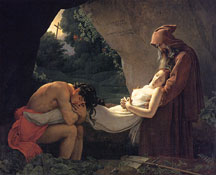
The Burial of Atala, 1767.
Anne-Louis Girodet De Roucy-Trioson
View larger image
The Witch of Endor
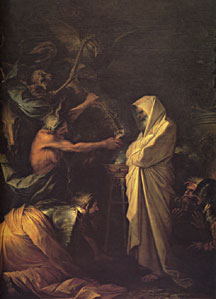
Salvator Rosa
The Spirit of Samuel Called up before Saul by the Witch of Endor, 1668 .
View larger image
Today’s required reading . Among other labyrinthian connections, Charlie is my godson.
Rembrandt
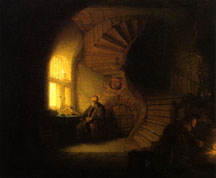
Philosopher In Meditation, 1632.
Scanned from Paintings In The Louvre by Lawrence Gowling
View larger image
Not that this reminds me of anybody in my house.
Life Support
Jennifer
My daughter at college was on my mind after the blog about what people have read. (I canÃt deal with reading any of the recommended reading though.) I was thinking about sharing some of our important early read-alouds: The Wonderful Adventures of Nils, Mary Poppins (the BOOKS, *N*O*T* the movie!), and The Jungle Book. That really has nothing to do with the next part, except that she rarely calls, and then she did.
She didnÃt want to talk to me, just her sister. Whatever it was, Hilary didnÃt want to do it; she suggested a friend now at Oberlin; then another relative. Eventually, I got back on the phone. It turned out she needed to fill out her health care proxy form for a class, and she felt parents were too irrational about their kids. I listened. Her: ìI mean, have you seen that woman in Florida? SheÃs like a trained seal. 15 years …î Me: ìWait a minute. Remember me? Remember the parrot?î (I had to remind her about the parrot, but she got it. You folks can just look back some days on the blog*) ìSo, mom, have you guys filled out your health care proxy?î (No. So sheÃll bring forms home next break.)
And then the conversation with her dad: Me: ìShe needed someone to be her health care proxy.î Him: ìYou know, you have to be careful. She may not feel loved, if you agree to cut off life-support.î ìI had to remind her about the parrot in order to pass.î (I had to remind him about the parrot too. He doesnÃt read the blog either.)
ìDid you know the parrot at Brandeis is the smartest parrot in the world? ItÃs been being trained for 25 years, by students.î ìItÃs the smartest, or it can do the most?î I started thinking, I bet 3 year-olds could learn way more than most of them do, except that they only spend a year being 3. Would that make them smarter?
* Reprinted from an earlier blog post:
“I once went into an exotic pet store with La Chica, age 6ish. She wanted a parrot or something like it. I was relieved that the prices were such that clearly we weren’t going there, but trying to be polite to the salesman. He bragged something along the lines of “They have the intelligence of a three-year-old, and they live to 40.” (My numbers may be off by a factor of 2.) I couldn’t think of a worse fate. Even La Chica seemed daunted. “