September 30, 2004
MCAS
When Matt was taking the MCAS tests last spring, he said they were so easy, he finished with hours to spare. Pencil down and up and out of the classroom. Diane and I looked at each other and back at Matt, and as fatherly as possible, I said, “You know, there is such a thing as checking your answers.” As he often does, he shrugged me off.
His test scores arrived today. The scores are ranked from Failing to Needs Improvement to Proficient to Advanced. He placed in the advanced category for both English Language Arts and Mathematics.
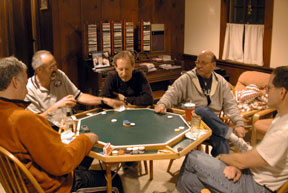
Poker at my house last night. Chris, have you played recently?
September 29, 2004
The Puddle
About a quarter of a mile from the Queijo's house you'll drive through a puddle. Mark includes that puddle when he gives out directions. It’s always there and it only varies in size. Stop at the puddle, look left and right, and you’ll see vast stretches of water on either side of the road. If you put a canoe in the water there, and paddled down stream you'd eventually get to the hundred acre pond on which his house sits. Eventually I say, because you'd have to portage that canoe around the beaver dam.
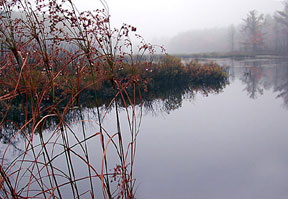
The water that creates that puddle.
Mark is a doer. He never stops and probably can’t. I could list all the things he’s accomplished recently, like the construction of his deck, but I won’t. Because it doesn’t matter. The point I’m making is that of all the building and chopping and creating he has done around his house, none of it impresses me as much as what he did near his house. He got rid of that puddle.
September 28, 2004
The King is Dead, Long LIve the KIng
by rakkity
Once upon a time in the days of yore (2002 CE), in the little borough
of Bowie in the kingdom of Maryland-sur-le-Bay, a father and son
started going to the court to practice their skills in the ancient
sport of racquet-le-balle. They did this on a regular basis,
usually twice, sometimes thrice (rarely frice) per fortnight. In the
beginning, the son made all the errors he was prone to: standing too
far back in the court or too close to the side, leaning in one
direction or the other, a little off balance, or showing by one sign
or another that he was expecting a shot from a certain direction. The
father duly noted these mistakes and took shameless advantage of
them, hammering the ball into untoward places, with unhappy effects on
the son's composure. Every time, he gently pointed out the son's
mistake, but took advantage to go onto win anyway. When the son leaned
north, the service ball passed south, and when the son leaned south,
the ball passed to the north. When he stood in the rear of the court,
the ball landed in the front, and when he stood close to the front,
the ball bounced behind him. And the scores were always lop-sided in the
father's favor.
Initially the two played with the old-style racquets of base metals,
and the son won an occasional game due to his speed and strength. But
the two players happily found newly-forged racquets of magical
lightweight metals, which increased the velocity of play. But with
these new racquets, the player's strength and speed made less of a
difference, but scheming play worked even better. After that, over
the weeks and months, the father ruled the court, losing not a game
during the subsequent year of play.
The situation changed when the teen-aged daughter, newly enscholared
at the local college, asked to join in an occasional game. Thence
forth, the games became three-somes, and the son and father played
left-handed, so as not to overwhelm their winsome partner. With this
arrangement, the daughter was competitive, but the son and father
still won a reasonable fraction of the games, and kept their right
arms rested for the occasional right-handed battle, which the father
persisted in winning.
Two years into these games, the son left the borough to seek his
fortune, but returned to town every Friday to test his mettle on the
court. During that year he seemed to grow still taller, and his arms
longer. He learned not to stand too far back or forward in the court,
and showed no tendency to lean to one side or the other. In the
father-son games, he commanded the center and, with his height and
reach, no corner of the court was safe for the ball to pass him by.
Still, by hook and treacherous crook, his old father managed to sneak
the ball around him, using wall-grazing returns with twisty spins and
semi-magical back-wall drops that eluded the son's reach.
Over time, the son developed a powerful back-hand, with all the
practice of returning balls that fell elusively to the back wall in
the depths of the corners, in such a way that only a back-handed smash
off the back wall had any chance of returning to the front wall. His
leaps and upward stretches made it almost impossible to loft a ball
over his head. His speed and lack of fear at crashing head-first into
the side walls made it difficult for the father to get a wall-grazer
past him. But the father just grew more cunning, and never repeated
exactly the same kind of shot in sequence.
The scores of these father-son games grew ever closer, sometimes with
the son losing only 10-15 or 11-15, and occasionally games would start
off with the son winning four, even five, serves in a row. But the
father knew the son's few remaining fatal weaknesses, and he would
proceed to win several points in a row, eventually pulling ahead and
going on to win. He played these games like chess, serving often to
the corner deeps, and sometimes making a surreptitious slow serve
right after a series of fast serves. He served shots that traced a z,
or a backwards z, making the ball apparently curve through the air,
re-bounding parallel to the court's back wall. In the early months,
serves like these used to bedevil the son and drive him to swing
futilely and miss, or if he didn't miss, return with a weak parry that
led the father to a kill.
The increasing skill of the son would have led inevitably, if only by
random luck, to a win against the father, except for the
fortuitous appearance on the scene of the old master Zarro.
---------------------To be continued----------------------------
September 27, 2004
Peace Please

More Noland
“Today, they’d probably throw me in jail.”
Noland doesn’t add history to his stories. Or background. But I do know he used to drink, and I do know both of his wives were alcoholics.
“David’s mother, she put a burning cigarette in my face. One punch, and she went down.” He’s a large man, with large fists and he jabbed the air, once, stopping right where her face might have been. “She was out for five minutes.”
“My second wife, she threw a glass ashtray that hit me in the face. Cracked a bridge and split my lip. I hit her and she was out for half an hour. I thought I killed her.”
September 26, 2004
Celtic Harp
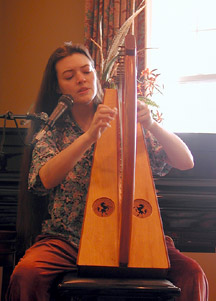
When Caera walked in and sat down on the piano bench with her Celtic Harp, I thought, Boy does she look Irish. Irish like Eileen Foley, with black hair and blues eyes. When she sang in Gaelic, I thought, I wonder how long she’s been in this country. After a song or two she talked about having just flown back from Ireland where she played in a village of Gaelic speakers. She wanted so badly to go back, she’d even written a sad song about her longings. I thought to myself, Why not just go home?”
I was so enamored by this Irish musician - I guess I’d been traveling vicariously with Susan- that my brain almost seized when, about midway through her gig, she said, “My first trip to Ireland was five years ago after I began exploring my heritage. After all, three out of my four grandparents are Irish.”
View larger image
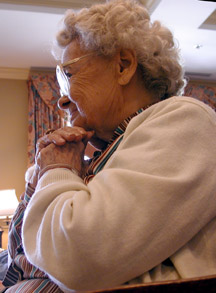
Flo told Caera about her own daughter's fascination with Ireland (Diane chimed in with, "She too has three Irish grandparents") and after the recital, Flo hurried up to her room, and returned to show Caera Susan's printed itinerary.
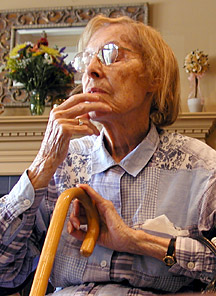
Flo's friend, Lois, enjoying the music, but secretly wishing Caera would sing in French.
September 25, 2004
Troyanoff
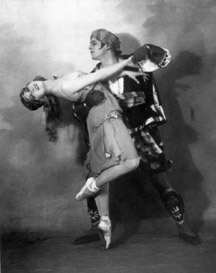
"Photo of pas des deux is from Le Corsaire - Semyon Troyanoff with Anna Liudmilla, c1927, Paris, costumes by Georges de Pogedaieff. "
Semyon Troyanoff is Steven's father's stage name.
September 24, 2004
Golovcsenko
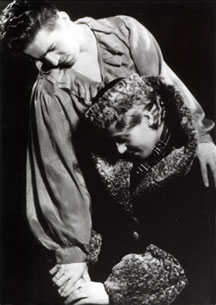
Steven Varga-Golovcsenko's parents - Semyon and Margit Varga-Golovcsenko
View larger image
September 23, 2004
Munich
Rakkity sent me this link . It's one friendly American's view of Germany, or more specifically, the Germans. Insightful and amusing, and if you read only one of the four pages he's written, I'd start with the last : Tuesday, September 21, 2004.
"...Germans (or maybe Europeans, I'm not sure everyone here is a German) are not the most outgoing people in the world. In the village, no one looks you in the eyes as you pass on the narrow path. There are no quick smiles from young girls on bicycles that stir an older man's imagination. There are no cheerful “Guten Morgens!” among strangers waiting at a bus stop. To have a conversation you almost have to be in a business transaction with someone. "
September 22, 2004
The Cook
From Sunday’s Globe Magazine
Squash, Green Bean, and White Bean Casserole
“Set the oven at 425 degrees. Spread the squash, flat side up, in a baking pan and sprinkle with olive oil, salt, and black pepper. Add 1/4 cup of the water to the edges of the pan. Roast the squash for 30 minutes or until it is almost tender when pierced with a fork. Set it aside to cool completely.”
And that would be about it for me. If I were the cook. But Diane is fearless, always has been, and she chopped and peeled and seasoned her way through the remaining six paragraphs as effortlessly as I click through web sites. Too me, cooking is like waiting in line. If I can throw a sword fish steak on the grill, flip it once after five minutes, then fine, I’ll do it. But paragraphs of instructions raises the same hackles as “Some assembly required.”
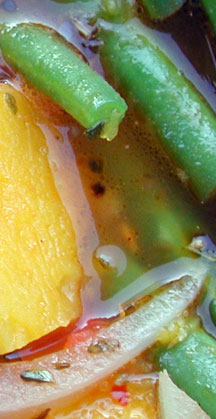
It's worth a closer look
While Diane cooked, I played grease monkey. I came home early to work on Diane’s overheating Mazda, and after a call to Peter, my all knowing brother-in-law, a hunt for the right tools inlcuding my not oft-used Ohm meter, and two trips to auto parts stores, with one stop at the library to scope out what Chilton’s Auto Repair recommends, I fixed it. The fan wasn’t spinning at idle, but now, with the newly installed coolant sensor, the temperature gauge no longer registers - Bail Out, The Car Is About To Explode.
However, the best thing is not the repair. I was ready to let Diane deal with that. Nope, it’s The Enemy. Rakkity told me he had just finished Lee Child’s latest book, but because it came from his library, he couldn’t send it north. I assumed there would be no chance of finding it at my library until half the town had read it, but no, it was right there on the Popular New Fiction shelf.
Speaking of rakkity, I asked him two questions we’ve all been scratching our heads about, and I could either paraphrase his answers or reprint, without his permission, his email.
> Whatever happened to this year's Beartooth saga?
“Yeah. That's what I'd like to know. Captain Phil and Surgeon
Reed have disappeared into the woodwork, and I can't do anything without their photos. Obviously they have different priorities than you and me. Sheesh! Don't they know the blog needs content?”
> You still playing racquetball with Patrick?
“Are you kidding? Does the pope drop trou in the woods? Do bears swing
from the balconies of the vatican? Is rakkity named rakkity?
As a matter of fact, last evening I started work on a new racquetball
story, "The King is dead, long live the King." But, what with 25th
anniversary festivities and all in the Schmahl house from Thurs to Sun,
I may not get it posted till next Monday, but I'll sneak a few minutes to
at least write it on my laptop (when my sweet S.O. isn't looking).”
Welcome Back From Ireland, Susan.
September 21, 2004
Jaguar
Saturday, we (Dan, Mark, Mark and Adam) all met at out favorite haunt, La Provence, in Concord. We’ve occupied tables there for hours at time, mostly in the back room which is offset from the main dining area. The last time we met for lunch, the back room was closed, and because it was so busy, we were eventually evicted by the owner, Robert Didier. Politely, to be sure, but nevertheless, told to take our garrulous butts and go elsewhere.
Though it wasn’t as busy this day, Robert was again stalking our table. Or so it seemed to me. He’d look out the plate glass window, then back at our table. Finally he walked over and asked, “Does anyone own a Jaguar?”
Adam and I simultaneously replied. “I wish.” But the couple sitting at the table behind us, closer to the window, offered, “We do.”
“I have some bad news, “ Robert said as the male half of the couple got up from his table. Robert put his arm on the concerned customer's shoulder and walked him to the window. “You have a flat.”
Clearly relieved that someone hadn’t sideswiped or backed into his car, the Jaguar owner sat back down at his table and said to his wife, “It could have been worse.”
Adam, who rarely includes himself in strangers' conversations, turned to the couple and said, “Yeah, it could have been a Corolla.”
September 20, 2004

September 19, 2004
Pumpkin
Pumpkin, Dolly Smith’s cat, was our cat’s best friend. She’d frequently sit somewhere on the lawn and look at our house, waiting for Skunk to join her. Skunk displayed little interest, but I’d always open the door and let him out. He would then stretch, lie on the deck, lick his paws, gaze at the sky, or occasionally run off with Pumpkin.

Skunk died in our house two years ago while we were in Hawaii, but Pumpkin still appears in our yard looking for her buddy to come out and play.
September 18, 2004
Morning
I wake and the sky
Is there, intact
The paper is white
The ink is black
My charmed life
Harms no one--
No wife, no son
Samuel Menashe

September 17, 2004
Headless Zaftig
Yesterday’s photo of Bill Lewis clearing snow off of his canoe with a wooden paddle brought this emailed response:
“Look at the picture you posted on the blog, the snowy one. That thing on the left looks like a zaftig headless, armless woman with very large breasts. I wonder what it means. Other than that distraction it's a gorgeous picture.”
That “distraction” was a snow woman (instead of breasts, I see Snoopy with those half arms looking more like ears) created by Adam, who sends this disclaimer:
“It means that Adam was at the time barely 30 , had been celibately in the woods for what at that time passed for a longish while, and was working out his own anxieties not with a knife to the throat, but by creating visions of comfort by turning the very stuff of threat into the stuff of play.”
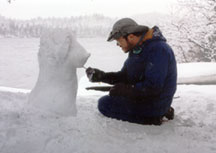
A closer look at the sculptor and the sculpture
The scene to which Adam alludes is Bill deciding to end it all because : A. We have canoed down a fast flowing river to get to this campsite and there is no way to paddle back up the river. B. The lake water is so cold that if we capsize we die, and C. We are in the middle of nowhere and our bodies won’t be found until spring. What Bill doesn’t yet know, and is an even better reason to cut his throat, is Adam’s plan - load the canoes with all of our gear and pull them overland back to our minivan. I don’t know the exact distance, but it took us two trips and eight hours.
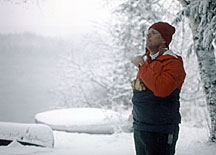
View larger image
The rest of the story written soon after the trip is here.
September 16, 2004
The Fall
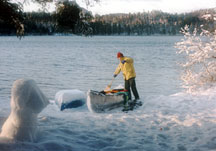
As we plan this year's fall camping trip... a look at the past, Allagash Lake, 1993.
View larger image
September 14, 2004
Idle Chatter
Flo comments frequently about others in her little community. Mostly, she refers to them as, well, “them”, or “they”, or “some,” as in , “some get picked up on weekends.” While we were waiting for the barbershop chorus to begin, she pointed out one woman in spiffy red shorts and matching spandex shirt. “She wears those same clothes everyday.” After the woman sat down, Flo asked me,
“Did you know it was Grandparent’s Day?”
" I've never heard of Grandparent’s Day, but I see the Happy Grandparent’s Day card on the piano.”
“Betsy and I were talking about it at lunch. I said it was Grandparent’s Day and the man at the next table thought I was talking about birthdays. He asked, “When is my birthday?”
That reads a little like he is asking Flo when her birthday is, but no, he’s asking when his is.
“I said, I don’t know. January, February, March, April, May...?”
“He said, ‘I think January.’
“You’re laughing, Flo.”
“I know. I shouldn’t, but I can’t help it.”
September 13, 2004
Last Night's Dream
Matt and I are in a valley, at the base of a mountain, trying to decide where to camp. It’s an area similar to many in Colorado, with a small town nearby. Adams comes along, pulls out his map and says, “We’ll begin at the top and camp at these lakes (pointing to his map as he talks) as we climb down. We’ll end our trip in this town, and eat here,” he says with a smile.
Two Photos from a wedding we stumbled on in Rhode Island.
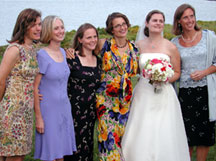
The bride and friends.
View larger image
September 12, 2004
Sounds Of Concord
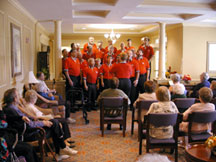
The Sounds of Concord Barbershop Chorus performed for almost an hour at Concord Park. The number in the Chorus (22) almost outnumbered those in the audience.
View larger image
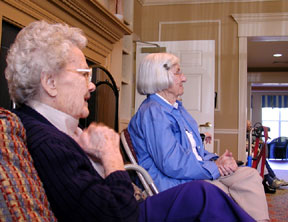
Flo, all ears.
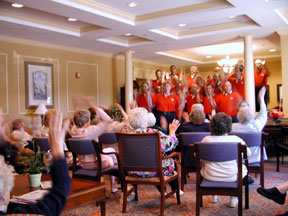
Audience participation. This is when I left my chair and pretended I had more photos to take.
September 11, 2004
Recurring Dream Themes
I’m usually going somewhere, and I’m pretty determined about it, but inevitably I get lost. Most times, I’m in Cincinnati, in the hills above the Ohio River. There are highways, buildings and bridges that cross the river. I’m usually on foot, and as if I suddenly had a stroke, I find myself lost. Which way to go? Don’t know. I’m not sure I even know where it is I am going.
The other night I dreamed that friend Eric was about to commit suicide, but not if I could reach him in time. He left white notes with numbers attached to various objects like street signs, fences, etc., and all I had to do was follow those notes. Behind me were other friends of Eric; I think Dan, Adam and Mark Schreiber. I was leading the group, following the notes, when suddenly I’m in a mall; a series of stores not unlike the street mall Peter took us to in Honolulu. When I emerge, I’m back in the twilight trying to follow Eric’s trail. The guys are again behind me, but suddenly they turn left when they should have gone straight and that’s the last I see of them. And it’s the last I see of Eric’s notes.
Within the same three week period:
I’m hiking into the mountains. Mountains not unlike Yosemite Valley. I’m looking for a place to camp, a place to bring Matt back to, but I get lost.
I’ve climbed to the top of Mt Monadnock but now the summit is covered in round snow-covered boulders, and I don’t have any shoes on. I can’t get down.
I’m driving a truck a friend of mine stole and I find myself back at the owner’s house, as he is about to come out of the door. I want to run, but it feels like it’s too late.
I’m driving a flat bed truck full of junk that has to be tossed before I get onto the highway. I’ve stopped just beyond the dumpster, but the traffic is too heavy and the truck too long to back up. Should I attempt to back up or risk losing the load on the highway? I can’t decide.
September 09, 2004
An Artist in the Making
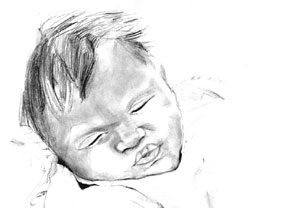
View larger image
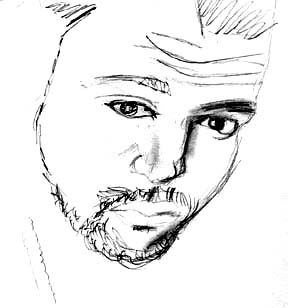
View larger image
Drawings by Caroline Radulski
I might have been working on her cabinet doors, or replacing her bulkhead steps, but way back in early 1990 something, I answered Chris Radulski’s phone (she must have been out and told me she was expecting a call).
“Hello.”
“Can I speak to Mrs. Radalooski?”
I laughed and thought to myself, how do you read a name and toss in syllables and non-existing letters? I told Chris about the phone call and she responded with, “I’ve heard much worse.” Unfortunately, from that moment forward, she has been - in my mind - Mrs. Radalooski.
Yesterday I ordered replacement windows from J & C Adams in Cambridge, for a job in Boxborough, and I was asked if I wanted low “e” glass. Trying to keep the price down, I waffled for a moment, when Joe, the salesman, said, “Let me check your past orders to see if you normally order them with low “e”. " I could hear him shuffling around (surely not through paper). When he came back to the phone he said, “Ah, here’s your last order. You did buy low “e” for the Radalooski job.”
Rakkity sent me Lonely Planet Unpacked, a collection of travel disaster stories. The disasters are not on the scale of Into Thin Air, although the first short story begins with an auto accident. Mostly they’re funny. Here is the first page of Pat Yale’s, A Costly Trip:
I could tell that something was wrong even before I opened my eyes. The ominous silence surrounding me was broken by a rhythmic swishing sound. For a moment I had no idea where I was. After all, in four months on the road there had been so many different beds.
I snapped open my eyes and hastily closed them again. What they had taken in was just too embarrassing: there I was, lying in solitary splendor on the floor of Nairobi Central Station with no other passengers in sight, just a lone sweeper with his twig broom working his way around the hall and studiously ignoring this single white female spread-eagled on her sleeping bag, her backpack for a pillow.
I glanced at my watch. Six o’clock. Just four hours earlier the scene had been very different when I’d crawled off the night train from Western Kenya with what looked like half of Nairobi. Then, apparently, no one had had a home to go to. I’d watched fellow passengers confidently unrolling blankets on the floor and preparing to bed down for the night, and hadn’t thought twice about joining them. With mugging a known hazard of visiting Nairobi, arriving post-midnight without a bed to call my own was inviting trouble How much more sensible to join this embryo squatter city and wait until daylight to brave the streets.
Now, it seemed, I’d slept through the cacophony of a massed departure. It was beyond credulity. Surely nobody could sleep that deeply.
September 08, 2004
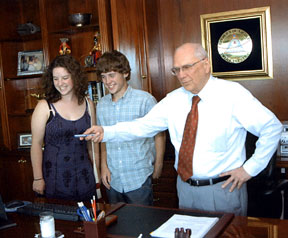
Enrique José Bolaños Geyer
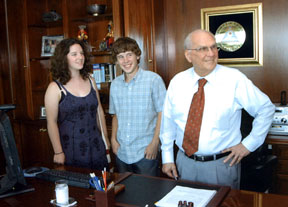
Hil, Matt and President Enrique Bolaños Geyer
View larger image
September 07, 2004
September 06, 2004
Bertha's Places
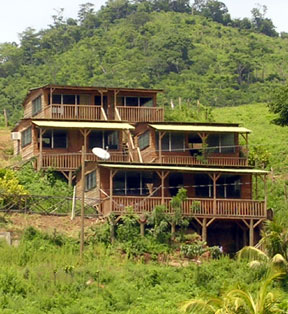
Photos of Bertha's beach house and her house in Managua.
Travis sent me this sound file about audio blogging. He may have been nipping a bad idea in the bud, I don’t know, but I rooted around some more in the author’s site and found this. Maybe a little long, but still, very funny.
On Sunday, Matt drove with Daryl to Woods Hole to take the ferry to the Vineyard. We hope he returns before school on Wednesday. This is his first (that we are aware of) road trip.
September 05, 2004
Epitome Of Summer
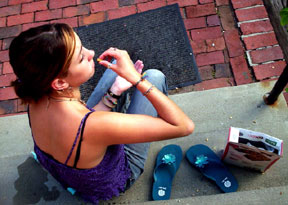
View image
This photo was taken by Chris’s sixteen year old daughter, Caroline. She titled it Epitome of Summer. I’m posting it, with permission, because I like pretty much everything about it: the girl’s sandals, the angle of her elbow, the frozen-in-the-moment quality, and the texture of the bricks and the concrete stoop in contrast to her skin.
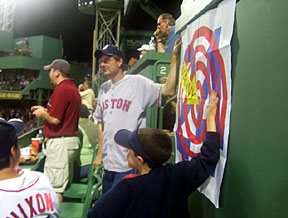
Mark and Matthew wait for Manny to comply.
View larger image
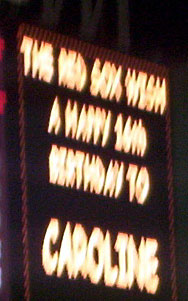
How about this night out for Chris and family? Monster seats at Fenway, the Red Sox beat the Angels, Cleveland clobbers the Yankees (22 to 0), and in neon - The Red Sox Wish A Happy 16th Birthday To Caroline.
September 02, 2004
Mostly for Adam's Father
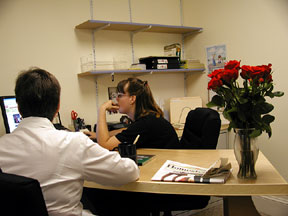
A few photos of the new office. The first two were taken during construction, and the blue tape on the walls and the wires hanging from the ceiling show the office is not quite finished, but in person the place is most impressive. Adam's well-crafted counter tops, especially the curved ones as you enter the office, are stunning.